Industry 4.0 Sounds Smart. But Is Your Business Ready for 2.0?
In this article
Industry 4.0 Sounds Smart. But Is Your Business Ready for 2.0?
Many business owners proudly say, “Now we want to move towards Industry 4.0.”
Some have started using even bigger words now — Industry 5.0, smart factory, AI, IoT, automation, digital twin.
Nothing wrong in that.
Ambition is good. Vision is good. Technology curiosity is also good.
But sometimes I feel we are using these words before understanding the journey behind them. It is like saying, “I want to drive a Formula 1 car,” when the basic road map, traffic rules, and vehicle maintenance are still not clear.
Industry 4.0 and 5.0 are not just versions like mobile software updates.
They represent how industries evolved over time.
And more importantly, they show how business thinking matured.
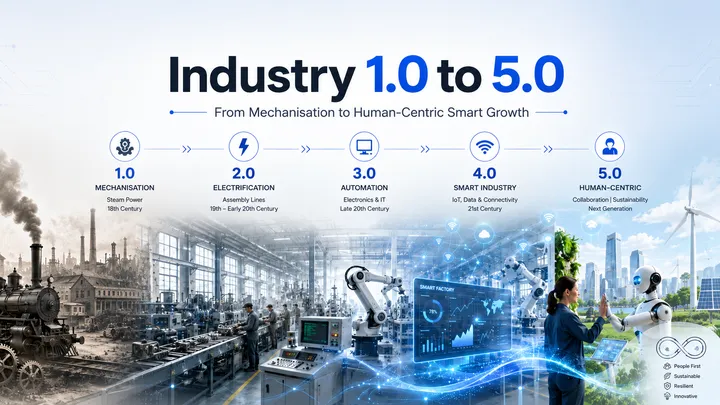
Where It Started: Industry 1.0
Industry 1.0 started with mechanisation.
Before this stage, most work was done manually. Human effort, animal power, and basic tools were the main strength. Then came machines powered by steam and water.
This changed production completely.
The core idea was simple:
Use machines to increase human capacity.
For business owners, Industry 1.0 teaches one important lesson: growth starts when we stop depending only on physical effort.
In today’s SME context, this may not mean buying a steam machine, obviously. It means asking:
“Is my business still dependent only on manual effort and memory?”
Industry 2.0: Power, Scale, and Standardisation
Industry 2.0 came with electricity, assembly lines, and mass production.
This was not only about producing more. It was about producing in a repeatable way.
- Same process.
- Same quality.
- Faster output.
This is where standardisation became powerful.
For today’s business owner, Industry 2.0 means SOPs, defined roles, proper workflow, quality checks, and repeatable systems.
If every staff member does the same task in a different way, the business is not ready for advanced automation yet.
First, the process must become clear.
Industry 3.0: Computers and Automation
Industry 3.0 brought computers, electronics, PLCs, software, and basic automation.
Machines started becoming smarter. Offices started using software. Data slowly moved from registers to computers.
But here is the interesting part.
Many businesses have computers, software, Excel sheets, WhatsApp groups, and still operate in confusion.
So Industry 3.0 is not achieved just because there is a computer on the table.
It is achieved when digital tools actually reduce confusion.
- A CRM that nobody updates is not digital transformation.
- An ERP that only one person understands is not system maturity.
Software should bring visibility, not new dependency.
Industry 4.0: Connected and Data-Driven Business
Industry 4.0 is about connected systems.
Machines, software, sensors, people, data, and decisions start talking to each other.
In simple words:
The business starts becoming visible in real time.
- For a factory, it may mean IoT sensors, production dashboards, machine monitoring, predictive maintenance, and live energy data.
- For a sales-driven business, it may mean lead tracking, follow-up reminders, quotation status, payment visibility, customer history, and team performance dashboards.
Industry 4.0 is not only for large factories.
The thinking can apply to every serious business.
The real question is not, “Do I have IoT?”
The real question is, “Can I see what is happening in my business without calling five people?”
That is the beginning of Industry 4.0 thinking.
Industry 5.0: Human-Centric, Sustainable, and Resilient
Industry 5.0 does not mean Industry 4.0 is old.
It adds a more mature layer.
It says technology should not only improve production. It should also support people, sustainability, resilience, and meaningful growth.
This is very important.
Because many owners think automation means removing people.
But good automation should remove confusion, repetitive burden, dependency, delay, and guesswork.
It should help people work better.
A good system does not make the team useless. It makes the team more capable.
Industry 5.0 brings the human back to the centre.
Technology should support human judgment, not blindly replace it.
The Real Problem: We Want 5.0 With 1.0 Habits
This is where many businesses struggle.
- They want smart dashboards, but data entry is not disciplined.
- They want automation, but the process is not defined.
- They want reports, but responsibility is unclear.
- They want growth, but everything still depends on the owner’s memory.
This is not a technology problem.
This is a clarity problem.
And clarity always comes before automation.
A Simple Readiness Checklist Before Starting This Journey
Before thinking about Industry 4.0 or 5.0, ask these simple questions:
- Are our main business processes clearly written?
- Do team members know who is responsible for what?
- Can we track leads, orders, payments, production, or service status without asking manually?
- Are follow-ups happening through system reminders or human memory?
- Do we review data regularly or only when a problem happens?
- Is our software supporting our process, or are we adjusting our business around software confusion?
- Can the owner take decisions based on visibility instead of assumptions?
If the answer is mostly “no”, then the first step is not advanced technology.
The first step is system clarity.
Growth Needs Version Upgrade in Thinking
Industry 1.0 to 5.0 is not only the story of machines.
It is the story of business maturity.
- From manual effort to machines.
- From machines to standardisation.
- From standardisation to computers.
- From computers to connected systems.
- From connected systems to human-centric intelligent growth.
For SMEs, this journey does not need to start with expensive technology.
It can start with one simple decision:
“I will stop running my business only through memory and follow-up calls. I will start building systems.”
That is a powerful beginning.
- Because when business becomes clear, decisions become faster.
- When data becomes visible, guesswork reduces.
- When processes become defined, teams perform better.
- And when systems become stronger, growth becomes calmer.
Industry 4.0 and 5.0 are not just about factories becoming smart.
They are about business owners becoming more systematic.
If this made you think about your own business, share your thoughts. Where do you feel this gap appears most — sales, team, operations, follow-up, production, or decision-making?

Chirag Gadara
System Thinker & Technopreneur
With over 18 years of experience across technology, automation, and enterprise systems, I help businesses eliminate bottlenecks and engineer simplicity for sustainable growth.