Meditation Is Not Always Sitting Still
In this article
Meditation Is Not Always Sitting Still
For a long time, I thought meditation means sitting quietly, closing the eyes, and trying to stop all thoughts.
And honestly, that idea itself was stressful.
Because the moment you try to stop thoughts, the mind suddenly becomes extra creative. It remembers pending work, old conversations, future worries, random ideas, and sometimes even things that have no relation with life at all.
So for many years, I was not doing any formal meditation.
But slowly, through life, work, programming, problem-solving, and self-reflection, I started understanding meditation differently.
- Not as a ritual.
- Not as a spiritual performance.
- But as a simple discipline of attention.
Meditation, As I Understand It
To me, meditation is the act of holding the mind steadily on one thing.
- That one thing can be your breath.
- It can be a sound.
- It can be one question.
- It can be one idea.
- It can even be your work.
The object is not the main point. The quality of attention is the main point.
When the mind stays with one thing, distractions slowly reduce. When distractions reduce, the mind becomes calm. When the mind becomes calm, clarity starts appearing naturally.
This is why I feel meditation is more natural than we usually think.
We may already experience small forms of it in daily life, but because it does not look like the traditional picture of meditation, we do not call it meditation.
Deep Work Also Has a Meditative Quality
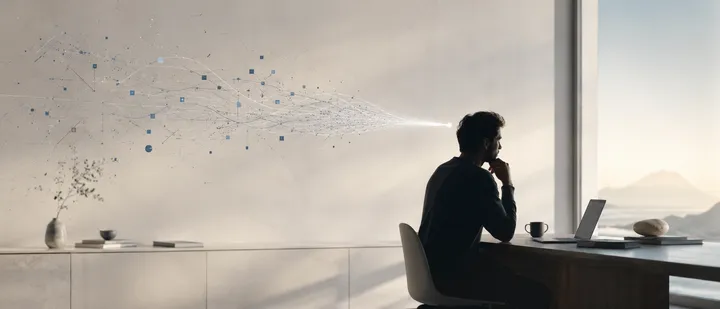
As a software developer, I have experienced this many times while programming.
There are moments when I am fully inside one logic, one problem, one flow.
- At that time, there is no outside noise.
- No unnecessary self-talk.
- No feeling of time passing.
- No pressure to impress anyone.
- Only the problem and the attention.
This state is very close to meditation for me.
Not because I am sitting in a special posture, but because the mind is not scattered. It is collected.
In programming, if the mind is jumping between ten things, the logic breaks. You miss small conditions. You create bugs. You complicate simple things.
But when attention becomes steady, the same problem starts opening itself.
- A complex flow becomes simple.
- A confusing structure becomes clear.
- A missing connection suddenly becomes visible.
This is not magic. It is attention doing its work.
A Founder Also Needs Mental Simplicity
In business also, the same thing happens.
Many times, the real problem is not that the business owner does not know what to do.
The problem is that the mind is carrying too many open tabs.
- Sales issue.
- Team issue.
- Payment follow-up.
- Customer complaint.
- Pending quotation.
- New idea.
- Old mistake.
- Future worry.
And in between all this, one more person says, “Sir, just one small thing.”
This mental load slowly creates confusion.
When the mind is scattered, even a small decision feels heavy. When the mind is calm, even a difficult decision becomes manageable.
This is why I believe clarity is not only a business requirement. It is also an inner requirement.
A confused mind creates confused systems.
A clear mind creates clearer processes, better communication, and calmer decisions.
The Simple Process
The process, as I understand it, is very simple:
- Choose one thing.
- Stay with it.
- The mind will move away.
- Bring it back gently.
- Repeat.
That is all.
- No drama.
- No fight with thoughts.
- No need to become blank immediately.
In fact, forcing the mind to become blank may create more pressure. The better approach is to simply return.
Again and again.
Slowly, the gap between distractions increases.
Then sometimes, for a few seconds, the mind becomes quiet by itself.
Those moments cannot be forced. They happen naturally when attention becomes deep.
Meditation In Daily Work
I feel meditation can happen in many simple forms.
- When you are reading with full attention.
- When you are solving a problem deeply.
- When you are listening to someone without preparing your answer in advance.
- When you are walking silently and observing your thoughts.
- When you are writing one idea with complete honesty.
- When you are working on something without constantly checking your phone.
These are not replacements for formal meditation for those who practice it seriously.
But they show one important thing.
Meditation is not far from daily life.
It is hidden inside the quality of attention we bring to daily life.
A Small Attention Check
Sometimes, instead of asking, “Am I meditating properly?” we can ask better questions:
- Can I stay with one thought for a few minutes?
- Can I listen without interrupting mentally?
- Can I work deeply without checking my phone again and again?
- Can I observe my thoughts without immediately reacting?
- Can I bring my mind back gently when it wanders?
These questions are simple.
But they reveal a lot about the condition of our attention.
And attention matters.
Because where attention goes, energy goes.
Where energy goes, life slowly takes shape.
The Real Simplicity
Today, I do not see meditation only as closing the eyes.
I see it as returning to one-pointed attention.
- Sometimes with eyes closed.
- Sometimes while working.
- Sometimes while thinking.
- Sometimes while solving a difficult problem.
- Sometimes while simply sitting quietly with yourself.
The deeper lesson is this:
A calm mind is not an empty mind.
It is a less scattered mind.
And a less scattered mind can see life, work, business, and decisions with more clarity.
- Maybe meditation is not about escaping life.
- Maybe it is about becoming fully present inside life.
If this made you think, share your thoughts. Have you ever experienced deep focus while working, reading, programming, creating, or solving a problem — where everything else became silent for a while?

Chirag Gadara
System Thinker & Technopreneur
With over 18 years of experience across technology, automation, and enterprise systems, I help businesses eliminate bottlenecks and engineer simplicity for sustainable growth.
Previous Posts From Founder Reflections

Why Simplicity Is Real Power
The Courage to See Yourself Clearly
What China’s Manufacturing Culture Made Me Think About Indian SMEs

The Third Person Theory: Why Problems Look Clear From Far Away