Why Growth First Feels Like Chaos Before It Becomes Clarity

In this article
Why Growth First Feels Like Chaos Before It Becomes Clarity
Have you ever tried to improve something in business, and suddenly everything started feeling more disturbed than before?
- You decide to bring a new system.
- You tell the team to follow a process.
- You start tracking leads, quotations, payments, production, follow-ups, or daily tasks.
And within a few days, instead of peace, you see confusion.
- Team members ask more questions.
- Old mistakes become visible.
- Pending work comes out.
- People say, “Sir, earlier it was easier.”
- And even you start thinking, “Was this change really needed?”
I have seen this many times with SME businesses.
The owner wants growth, but when the business starts moving from habit-based working to system-based working, there is a temporary discomfort. It feels like chaos.
But many times, that chaos is not a sign that the system is wrong.
It is a sign that the old way is being exposed.
Old Habits Feel Comfortable, Even When They Are Costly
Every business develops its own habits.
- Some businesses depend on the owner’s memory.
- Some depend on WhatsApp messages.
- Some depend on one senior staff member who “knows everything.”
- Some depend on diaries, Excel sheets, phone calls, and daily reminders.
Nothing wrong with these things in the beginning.
In the early stage, business works because people are close, volume is limited, and the owner can personally control most things.
But after some time, growth starts putting pressure on the same old habits.
- More inquiries come.
- More customers need follow-up.
- More quotations are pending.
- More payments need tracking.
- More team members need clarity.
- More decisions are waiting for the owner.
The same method that once helped the business survive now starts limiting its growth.
This is where maturity demands change.
And change always disturbs comfort first.
When Systems Enter, Hidden Problems Become Visible
A good system does not create problems.
It reveals them.
Before system thinking, a missed follow-up may look like “customer was not serious.”
After tracking, you may realise that the customer was interested, but nobody followed up for seven days.
Before process clarity, delayed quotation may look like “staff is slow.”
After visibility, you may realise that product details were unclear, approval was pending, or pricing responsibility was not defined.
Before payment tracking, cash flow stress may look like “market is tight.”
After review, you may realise that payment follow-up itself has no owner, no schedule, and no escalation.
This is uncomfortable.
Because earlier, confusion was hidden inside daily busyness.
Now it is visible.
And visibility can feel painful in the beginning.
But without visibility, improvement is almost impossible.
Growth Is Not Only More Sales
Many business owners think growth means more leads, more orders, more customers, or more revenue.
That is one part.
But real growth also means more capability.
- Can your team handle more work without daily shouting?
- Can your sales process continue even when the owner is busy?
- Can a new employee understand the workflow quickly?
- Can you know what is pending without asking five people?
- Can your business run with less memory and more clarity?
If the answer is no, then growth will bring more pressure, not more freedom.
This is why I often feel that business should not grow only in size. It should grow in maturity.
A bigger business with weak systems becomes a bigger headache.
A systematic business, even if small, feels more peaceful and scalable.
The Transition Phase Is the Real Test
There is a middle phase in every business transformation.
- Old habits are not fully gone.
- New systems are not fully adopted.
- Team is learning.
- Owner is adjusting.
- Mistakes are coming out.
- People are resisting.
- Some data is incomplete.
- Some processes need correction.
This phase feels messy.
But this is also the phase where real change happens.
It is like renovating a shop while the shop is still open. Dust will be there. Some shelves will move. Customers may ask what is happening. Staff may get irritated.
But after renovation, the same space becomes more useful.
Business systems are also like that.
During change, things may look disturbed. But if the direction is right, the disturbance slowly becomes structure.
A Simple Way To Understand This Chaos
Whenever growth feels chaotic, ask these four questions:
- Is this chaos created by the new system, or was it already present but hidden?
- Are people confused because the process is wrong, or because the process is new?
- Is the owner still becoming the final answer for everything?
- What is becoming visible now that we were ignoring earlier?
These questions help you avoid emotional decisions.
Because many times, owners stop system improvement too early.
They see discomfort and think the new method is not working.
But sometimes the system is working exactly as it should — by showing the truth.
Software Alone Will Not Create Clarity
This is also where many businesses misunderstand technology.
They buy software and expect automatic discipline.
But software cannot fix unclear thinking.
- If responsibility is not clear, software will only show confusion digitally.
- If follow-up culture is weak, CRM will become a storage place.
- If approval rules are unclear, ERP will become a bottleneck.
- If people are not trained, automation will create more dependency.
Technology should support clarity.
It cannot replace clarity.
First define the process. Then bring the tool. Then train the team. Then review regularly.
This is slow in the beginning, but powerful in the long run.
Pain Is Not Always Negative
In business, every discomfort is not a bad signal.
Sometimes discomfort means the business is stretching beyond its old capacity.
- A team member who was working only by memory is now learning accountability.
- A sales process that was casual is becoming reviewable.
- A business owner who handled everything personally is learning delegation.
- A company that worked on assumptions is moving toward data.
This is maturity.
And maturity rarely feels comfortable at first.
Even in personal life, when we start a new discipline — exercise, diet, reading, waking up early — the first few days feel difficult. Not because the discipline is wrong, but because the old habit is still strong.
Business is also made of habits.
To change business results, we have to change business habits.
Clarity Comes After Repeated Correction
Clarity does not come in one meeting.
It comes through observation, correction, review, and patience.
- You define a process.
- Team follows it partially.
- You find gaps.
- You improve it.
- Someone misunderstands.
- You simplify it.
- Some data is missed.
- You make it easier.
- Slowly, people understand.
- Slowly, work becomes visible.
- Slowly, dependency reduces.
This is how systems mature.
Not by one perfect decision.
But by consistent improvement.
The Real Question
When growth feels chaotic, do not immediately ask, “How do I stop this discomfort?”
Ask, “What is this discomfort trying to show me?”
- Maybe it is showing owner dependency.
- Maybe it is showing weak follow-up.
- Maybe it is showing unclear roles.
- Maybe it is showing that your business has grown, but your systems have not grown with it.
That realisation itself is valuable.
Because once you see the real problem, you can start building the right solution.
Growth first feels like chaos because it breaks old comfort.
But if handled with patience, clarity, and system thinking, the same chaos becomes the foundation of a stronger business.
If this made you think about your own business, share your thoughts. Where do you feel this transition pain appears most — sales, team, operations, follow-up, or decision-making?

Chirag Gadara
System Thinker & Technopreneur
With over 18 years of experience across technology, automation, and enterprise systems, I help businesses eliminate bottlenecks and engineer simplicity for sustainable growth.
Previous Posts From Business Growth

Everyone Wants an Autopilot Business. Few Are Ready to Build the Runway.

Growth Is Not Just Ambition, It Is Responsibility

Why Do Some Business Owners Keep Growing While Others Stay Stuck?
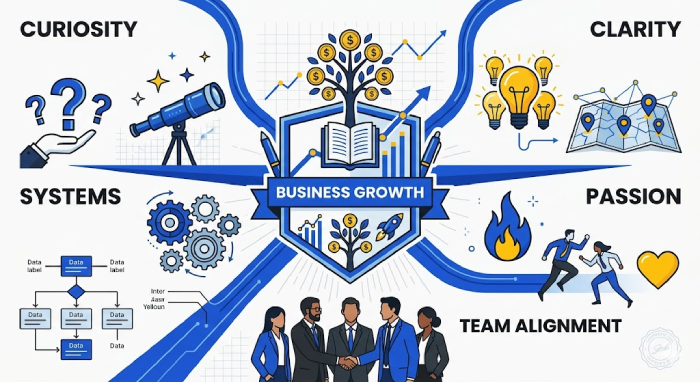
What I Learned About Growth from Curiosity, Clarity and Systems